Technical Briefing · Enterprise integration · For group CIOs, IT directors, COOs and medical directors
Every multi-site veterinary group is running an integration strategy. Most just never chose it. It grew one acquisition, one lab contract and one insurer portal at a time, and today it lives in a tangle of vendor-owned interfaces, nightly exports and the hands of front-desk staff who re-type the same pet into four systems.
That tangle is the most expensive system in the group, and it appears on no budget line. Quill believes it is also the single biggest thing standing between veterinary teams and the care they trained to give.
This briefing makes the case for a neutral integration layer: one canonical veterinary data model, one event backbone and one governed boundary that every PIMS, lab, imaging system, pharmacy, payment processor and insurer connects to once. It explains the architecture, shows how to model the return, and lays out how a group can move to it, and later to a new PIMS, without closing a single hospital for a weekend.
01 · THE INTEGRATION TAX
Groups pay for missing integration three times.
In staff hours, in engineering hours and in cash that arrives late.
Walk through a single insured dental extraction at a hospital that joined the group last year. The visit is charted in that hospital's PIMS, which is not the PIMS the rest of the group uses. Pre-anesthetic bloodwork comes back from the in-house analyzer through a vendor interface written for that PIMS only. The invoice is built, then someone re-reads the note, downloads the lab PDF, logs into the insurer's portal and re-keys it all into a claim. Payment posts in the processor. A regional manager learns about margin three weeks later from a spreadsheet stitched together from four exports.
None of those systems is broken. The space between them is broken, and every group fills that space the same way: with people.
Process flow · Illustrative
What the tax looks like on the ground
- Re-keying. The same owner, pet, diagnosis and invoice lines typed into the PIMS, the lab portal, the insurer portal and the payments terminal.
- Integration debt. Every acquired hospital arrives with its own PIMS, and every vendor connection has to be rebuilt for it, or abandoned.
- Silent failures. A lab result that never posts, a claim that never leaves, a payment that never reconciles. With no shared transaction trace, nobody sees it until a client or a carrier calls.
- Slow cash. Claims assembled by hand after the visit, submitted blind and denied weeks later for a field that was available all along.
- Locked-in roadmaps. When the PIMS is also the integration hub, every new partner, workflow or AI tool waits on one vendor's release calendar.
The groups that win the next decade will not be the ones with the most software. They will be the ones whose software finally talks to itself.
02 · WHY POINT TO POINT BREAKS

Point to point grows by multiplication; a layer grows by addition.
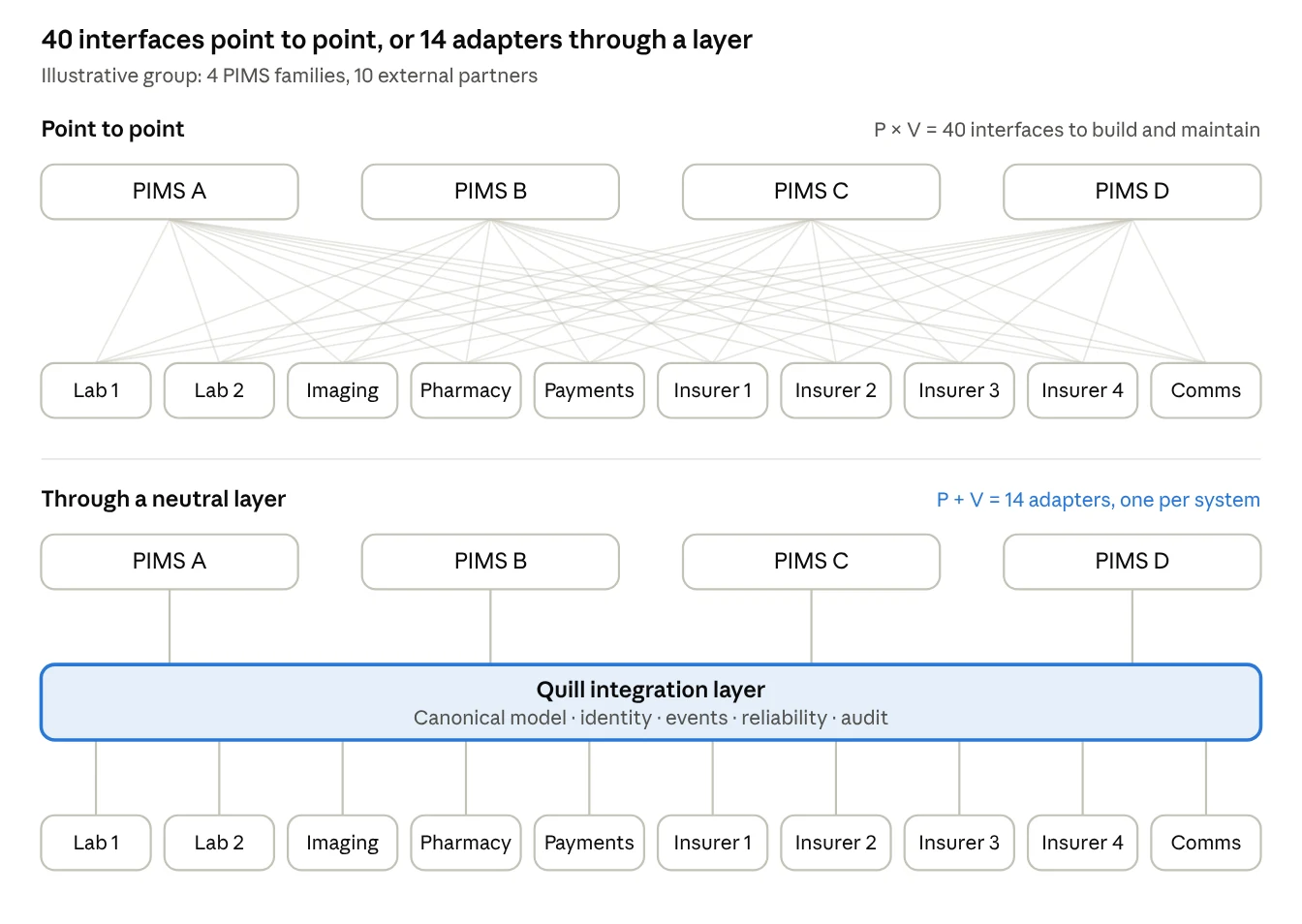
A single-site practice can live with one PIMS and a handful of vendor interfaces. A group cannot. Acquisitions bring new PIMS families, and every partner has to be rebuilt for each one, or the new hospital simply runs without it. Each interface is owned by a different vendor, versioned on a different schedule and monitored by nobody in particular. When something fails, there is no single place to see it.
The fix is not a better interface. It is a different shape: every system connects once, to a layer the group controls, and the layer does the translating.
03 · THE ARCHITECTURE
One boundary the group controls.
The layer sits between the people who use data and the systems that hold it, so neither side has to know how the other works.
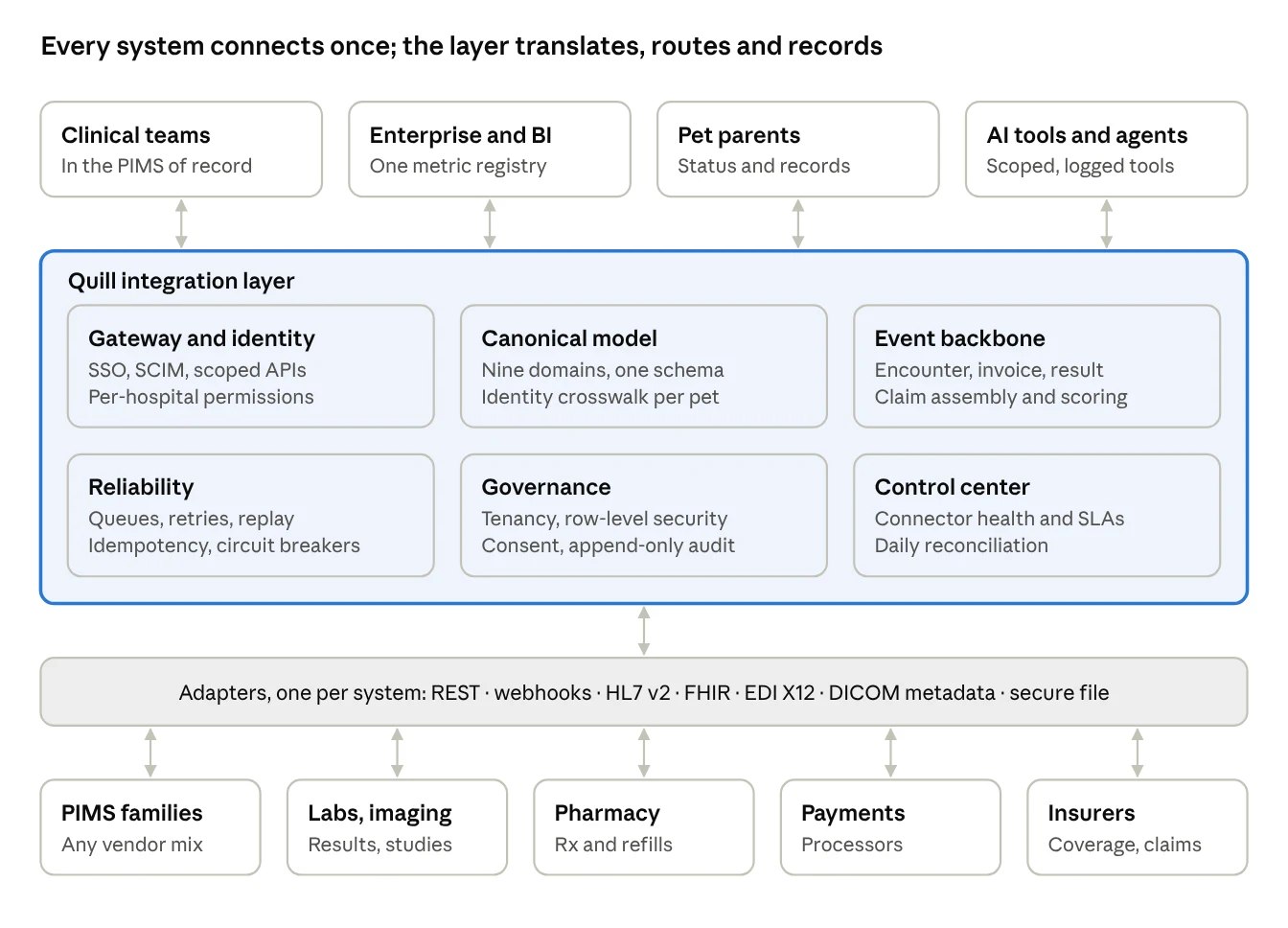
Clinicians keep charting in their PIMS of record; nobody is asked to double-document. Above the layer, enterprise teams, pet parents and AI tools read one consistent model. Below it, each external system connects through a single adapter in its own protocol. Inside it, six components do the work no individual vendor can: identity, a shared model, events, reliability, governance and an operational control center.
04 · TECHNICAL ANATOMY
What makes a layer, not another interface.
An integration layer earns the name only if it owns six things: the data model, identity, events, adapters, reliability and the audit trail.
A canonical veterinary resource model
Every system is translated once into a shared model, and every other system reads from that model. Quill's model spans nine domains:
| Domain | Representative resources |
|---|---|
| Enterprise | Organization, LegalPractice, Hospital, Provider, User, Role, ExternalPartner |
| Identity | Owner, Pet, Identifier, Microchip, Crosswalk, Consent |
| Scheduling | Appointment, AppointmentType, Resource, PreVisitIntake |
| Clinical | Encounter, Vitals, Problem, Diagnosis, Procedure, ClinicalDocument, TreatmentPlan, Medication, Vaccination |
| Diagnostics | LabOrder, LabResult, ImagingStudy, ImagingReport |
| Financial | Estimate, Invoice, InvoiceLine, Payment, Refund, Authorization |
| Insurance | Policy, CoverageCheck, Claim, ClaimLine, Evidence, AdjudicationResult |
| Pharmacy | PrescriptionRequest, Approval, Refill, FulfillmentStatus |
| Governance | Provenance, AuditEvent, IntegrationTransaction, ReconciliationResult |
The model is deliberately stable whichever PIMS sits underneath it. That single design choice is what turns a PIMS from a permanent commitment into a replaceable component.
Identity that survives acquisitions
The same dog exists as three records in three PIMS. A crosswalk keeps every source identifier permanently and resolves them to one canonical owner and pet, so history follows the patient across hospitals, referrals and systems, with consent attached.
An event backbone, not nightly batches
Work moves on events: appointment created, encounter opened, estimate updated, invoice finalized, lab result final, claim status changed. When an invoice is finalized, the layer assembles the claim evidence package and scores it before anyone opens a portal. When a carrier updates a claim, the state change flows back to the hospital in minutes, not in a monthly statement.
Process flow · Illustrative
Adapters that absorb vendor change
Each PIMS, lab, imaging system, pharmacy, processor and insurer gets one adapter behind the boundary, speaking its native protocol: REST and webhooks, HL7 v2, FHIR, EDI X12, DICOM metadata or secure file exchange. When a carrier changes its schema, one adapter changes. Nothing inside the hospital does.
Reliability by design
A layer that becomes another single point of failure has failed. These controls make it the opposite: the boundary that keeps one partner's outage from reaching the exam room.
| Control | What it prevents |
|---|---|
| Correlation IDs across every hop | Lost transactions nobody can trace |
| Idempotency keys | Duplicate claims, payments, refills or results |
| Sequence and version checks | Out-of-order updates overwriting newer data |
| Durable queues with replay | A partner outage turning into lost work |
| Circuit breakers and short timeouts | A slow vendor freezing charting or checkout |
| Bulkheads per partner and hospital | One noisy integration starving the rest |
| Daily reconciliation of counts, amounts and states | Silent drift between systems |
| Explicit source-of-truth rules per domain | Two systems both believing they own the record |
Governance and security at the boundary
Tenancy follows how groups are actually built: enterprise, legal practice, hospital, user. Hospital records are isolated with row-level security; enterprise users see approved aggregates, not every chart. Identity runs through enterprise single sign-on with SCIM provisioning, secrets live in a managed vault, data planes sit on private networks, and every access and change lands in an append-only audit log. Every connector is certified before it touches production, with its own kill switch.
A governed gateway for AI
AI tools and agents never get the database. They get narrow, scoped tools such as get pet context, get recent labs or create scribe draft, each permissioned and logged. That is how a group adopts AI quickly without handing an unvetted agent the keys to every record.
05 · THE ROI CASE
About $1.0 million a year, before a single AI feature.
In the illustrative 40-hospital group below, a neutral integration layer returns about $1.0 million a year in gross value, roughly $25,000 per hospital, before a single AI feature is switched on.
The math starts with one structural fact. A group running P different PIMS and connecting V external partners point to point needs P × V interfaces. Through a layer it needs P + V adapters.
Interfaces (point to point) = P × V · Adapters (through a layer) = P + V
Four PIMS families and ten partners means 40 interfaces to build and maintain, or 14 adapters: a 65% cut in integration surface. Every acquisition that brings a new PIMS adds V interfaces the old way, and one adapter the new way.
Worked example (illustrative)
Group profile: 40 hospitals, 4 PIMS families, 10 external partners (2 labs, imaging, pharmacy, payments, 4 insurers, client communications), 25 visits per hospital per day, 300 operating days, 8% of visits generating an insurance claim.
| Value driver | Illustrative inputs | Annual value |
|---|---|---|
| Re-keying eliminated | 300,000 visits × 3 minutes saved × $28/hour loaded staff cost | $420,000 |
| Interface maintenance avoided | 26 fewer interfaces × 80 hours/year × $150/hour | $312,000 |
| Acquisition onboarding | 1 new PIMS family/year: 1 adapter instead of 10 interfaces, 120 build hours each at $150/hour | $162,000 |
| Claim assembly automated | 24,000 claims × 10 minutes saved × $28/hour | $112,000 |
| Total gross annual value | $1,006,000 |
Not counted above, and often larger: cash that arrives weeks sooner when claims are scored and submitted the day of the visit; denials avoided because a missing field was caught in the room; lost lab results and unreconciled payments that never happen; and every vendor or AI tool the group can adopt without waiting on a PIMS release.
Turn it into your number
ROI = (Annual value − Annual platform cost) ÷ Annual platform cost · Payback (months) = One-time implementation cost ÷ (Annual value − Annual platform cost) × 12
Every input above is a placeholder, and we say so deliberately. Quill does not ask any group to buy on marketing metrics. In a joint discovery phase we baseline your real re-keying minutes, interface hours, claim touches and days to cash from your own telemetry and tickets, so the business case is built on your evidence, not ours.
06 · INTEGRATION FIRST, PIMS SECOND

Change without closing a hospital.
The integration layer is not only a better way to connect today's systems. It is the safest route we know to change the PIMS itself.
PIMS migrations fail for four reasons: a hard cutover date, data that does not reconcile, staff retrained at the moment of change, and integrations that break when the system of record moves. Deploying the layer first removes all four, because partners already connect to the layer, not to the PIMS. When the system of record changes underneath, the lab, the insurer and the processor never notice.
Process flow · Illustrative
The design has one more property that matters to a board: no stranded investment. If the group decides never to change its PIMS, it still lands on a fully working integration and transaction platform. Every artifact built in step 1 is a required part of step 4, so optionality costs nothing extra.
07 · WHY QUILL, AND WHY NOW
A veterinary specialist built for exactly this job.
Quill is a veterinary specialist built for exactly this job, and we intend to change how groups buy and connect practice technology.
The incumbent model asks a group to choose a PIMS and then live inside its walls: its integration list, its roadmap, its release calendar. As PIMS vendors are folded into larger companies with their own clinics, pharmacies and insurance interests, that dependency stops being a technical detail and becomes a strategic one. Groups deserve a layer they control.
What sets Quill apart
- Built from the claim backward. Most platforms start at the appointment book and bolt finance on later. Quill was engineered around the full loop: documentation to coding, coding to claim confidence, claim to cash, cash to measured outcomes. That is why insurance, payments and analytics sit natively in the model instead of in a partner's portal.
- Neutral by design. No carrier, processor, lab or PIMS gets privileged treatment in the canonical model. The group chooses its partners; the layer serves them all.
- Engineered for evidence. One metric registry so the hospital tile and the board report cannot disagree; claim rules measured on catch rate and dollar impact; AI models promoted only after passing evaluation gates; every number drillable to its rows.
- Enterprise-grade, specialist-fast. Azure-native architecture with single sign-on, private networking, managed secrets and append-only audit, delivered by a team for whom veterinary groups are the whole business, not one vertical among twenty. Group requirements reach the backlog directly, with named engineering owners.
- Honest about status. We label every capability, and we expect every vendor you evaluate to do the same.
| Capability | Status |
|---|---|
| Canonical veterinary resource model | Current design |
| Insurance exchange and QuillGuard pre-submission claim scoring | Pilot |
| Payments state machine and double-entry ledger | Current design |
| Enterprise analytics and metric registry | Current design |
| Multi-model AI gateway with evaluation gates | Current design |
| PIMS adapters | Planned |
| Reference lab and imaging adapters | Planned |
| Scoped clinical AI tools for agents | Planned |
| SOC 2 Type II | Audit planned; no report yet |
We believe the next decade of veterinary technology belongs to the platforms that connect, not the ones that contain. Quill is building that platform for the teams who put patients first, because every minute a technician spends re-keying an invoice is a minute not spent with a patient, and every claim a family has to chase is a reason to decline the care their pet needs.
08 · TEN QUESTIONS FOR EVERY VENDOR
Put these to any integration or PIMS vendor.
Whether or not you talk to Quill, put these to every vendor on your shortlist.
- Is your data model published, and does it stay the same if we change PIMS?
- How many interfaces do we need for our PIMS count and partner count, and who maintains each one?
- How do you resolve one patient who exists in three systems, and do you keep every source identifier?
- Show us one transaction traced end to end, from encounter to payer to cash.
- What happens to our claims and lab results when a partner is down for four hours?
- How do you prevent a duplicate claim or payment if an event is delivered twice?
- What do you reconcile daily, and who sees the exceptions?
- How is each hospital's data isolated from the enterprise and from other hospitals?
- What can an AI tool or agent access through your platform, and where is that logged?
- Which capabilities you showed us today are live, which are in pilot and which are planned?
Connect once. Change anything.
Quill helps multi-site groups map their integration estate, model the return on their own numbers and design a path to a neutral layer, and to a new PIMS when they are ready, without closing a hospital for a day.
Start with an integration discovery: an inventory of your PIMS families, partners and interfaces; a baseline of re-keying, interface hours and claim touches; and a sequenced plan with gates your team controls.